
Your website is more than just an online presence. It is often the first place potential customers go to understand your business, explore your services, and decide whether they want to contact you.
That makes choosing the right website platform an important decision.
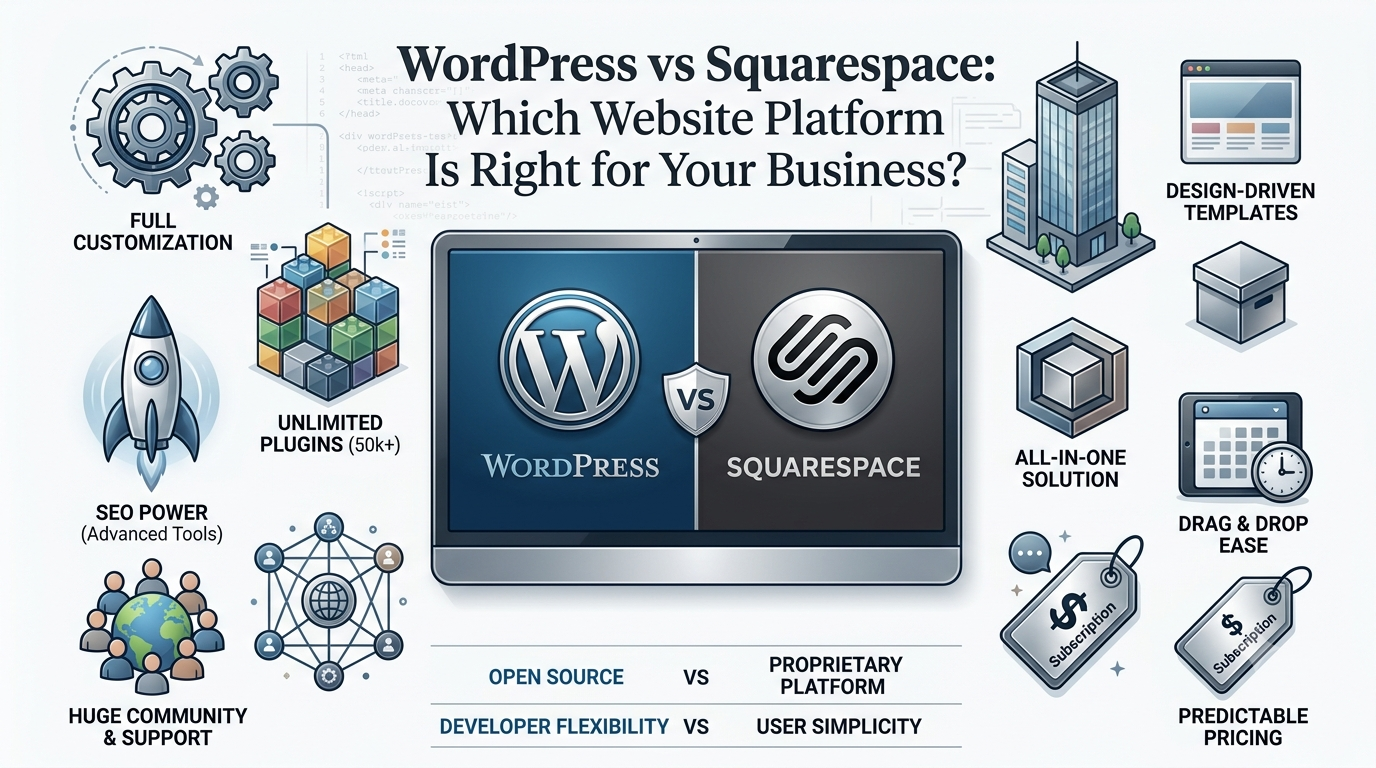
Two names that frequently come up when building a new website are WordPress and Squarespace. Both can be used to create professional, mobile-friendly websites, but they are designed around different priorities.
WordPress gives you a high level of control and room for customization. Squarespace takes a more streamlined approach, bringing website building, hosting, templates, and many essential features together in one platform.
So, when it comes to WordPress vs Squarespace, which one is better for your website?
There is no universal answer. The better choice depends on how you want your website to work today, how much control you need, and where you expect the business to go in the future.
WordPress vs Squarespace at a Glance
| WordPress | Squarespace | |
|---|---|---|
| Website setup | More flexibility during setup | Simple and streamlined |
| Design freedom | Very high | High |
| Custom functionality | Excellent | More limited |
| SEO flexibility | Excellent | Strong |
| Maintenance | Requires more attention | Mostly handled for you |
| Content-heavy websites | Excellent | Good |
| Business websites | Excellent | Excellent |
| Complex websites | Better suited | Can become restrictive |
| Ease of management | Depends on setup | Very easy |
The most important difference is simple:
WordPress gives you more control, while Squarespace gives you more simplicity.
Understanding the Difference Between WordPress and Squarespace
Before comparing individual features, it helps to understand what each platform is trying to achieve.
WordPress is a flexible content management system. Your website can be extended through themes, plugins, custom development, integrations, and different hosting environments. This makes it suitable for everything from a small company website to a large content platform or ecommerce business.
Squarespace takes a more controlled approach. Instead of assembling different parts of your website environment yourself, you get an integrated platform where the website builder, hosting, templates, security, and many core features work together.
That difference affects almost every part of the website-building experience.
Design and Customization
The visual appearance of your website matters, but so does the freedom you have to change it later.
WordPress
WordPress offers extensive design flexibility. You can start with an existing theme, customize it heavily, use a page builder, or create a completely custom design.
You can also modify the underlying functionality when your requirements go beyond what a standard theme provides.
This makes WordPress particularly useful when a website needs a unique layout or features that aren’t available through a standard website builder.
Squarespace
Squarespace focuses on giving you polished design options without requiring extensive technical work.
Its templates and visual editing tools make it possible to create a professional website relatively quickly. For many businesses, this is exactly what they need.
The trade-off is that you work within the capabilities of the Squarespace platform. You have plenty of design control, but not the same level of freedom available with a fully customizable WordPress website.
If design freedom is your priority, WordPress has the advantage. If you want a polished website without a complicated setup, Squarespace is a strong option.
WordPress vs Squarespace for SEO
SEO is often one of the biggest concerns when choosing a website platform.
The good news is that both WordPress and Squarespace can be used to build SEO-friendly websites.
Squarespace provides several SEO features as part of the platform, including options for page titles, descriptions, clean URLs, XML sitemaps, mobile optimization, SSL, and structured data.
WordPress gives website owners more room to customize their SEO setup. Depending on the website, you can use dedicated SEO tools, custom development, structured data solutions, redirects, and other technical configurations.
That additional flexibility can be particularly useful for websites with large amounts of content or more advanced SEO requirements.
However, choosing WordPress does not automatically make a website rank better.
A well-structured Squarespace website with useful content and strong authority can outperform a poorly optimized WordPress website. Current industry analysis also shows that Squarespace sites can achieve substantial organic traffic when their content, links, and on-page SEO are handled properly.
What actually matters for SEO?
Regardless of the platform, your website should have:
- Useful, original content
- Clear page structure
- Search-intent-focused content
- Descriptive page titles
- Relevant meta descriptions
- Proper internal linking
- Optimized images
- Mobile-friendly pages
- Good website performance
- A logical URL structure
- Quality backlinks where appropriate
So if someone asks, “Is WordPress better than Squarespace for SEO?”, the honest answer is:
WordPress generally offers more SEO control, but both platforms can support a successful SEO strategy.
Which Platform Is Easier to Manage?
This is where the difference becomes very noticeable.
A WordPress website can be extremely easy to manage once it has been properly built. However, depending on how it is set up, there may be themes, plugins, hosting, updates, backups, security, and performance considerations to look after.
Squarespace removes much of that responsibility by providing an integrated environment.
For a business owner who doesn’t want to think about technical website maintenance, this can make Squarespace especially appealing.
You can focus on updating your services, publishing content, adding images, and managing the business rather than worrying about the technical side of the website.
For simplicity and day-to-day management, Squarespace has the edge.
Which Platform Gives You More Room to Grow?
Growth can mean different things.
Maybe you want to add a blog. Maybe you eventually need an online store. Perhaps you want customer accounts, advanced integrations, a membership area, or a custom application.
WordPress is particularly strong when the website is expected to become more sophisticated over time.
Its ecosystem allows developers to add new functionality without necessarily rebuilding the entire website.
Squarespace can also support growing businesses, particularly when the website remains within the platform’s intended use cases. But if your requirements become highly specialized, you may eventually find yourself working around platform limitations.
This is one reason businesses with more complex long-term plans often choose WordPress.
What About Website Performance?
Website speed is important for both visitors and search visibility.
But the platform itself is only part of the equation.
A WordPress website can be very fast when it is built with a lightweight theme, optimized images, efficient hosting, sensible plugins, and a well-planned structure.
At the same time, an overloaded WordPress installation can become unnecessarily slow.
Squarespace handles much of the underlying technical environment for you, which means you don’t have the same level of control over every performance variable.
The practical lesson is simple:
A properly built website matters more than simply choosing WordPress or Squarespace.
A fast, clean website on either platform can provide a much better experience than a poorly built website on either platform.
WordPress vs Squarespace for Small Business Websites
For a small business, the decision usually comes down to priorities.
If you want a website that is straightforward, professional, easy to update, and doesn’t require much technical involvement, Squarespace can be a very practical choice.
If you want complete control over the design, plan to add custom functionality, or expect the website to become an important part of your marketing and content strategy, WordPress may make more sense.
Squarespace may be a better fit when:
- You want to launch quickly
- You prefer a simple editing experience
- You don’t want to manage technical updates
- Your website has relatively straightforward requirements
- You want professionally designed templates
- You want many essential features available in one platform
WordPress may be a better fit when:
- You need extensive customization
- You want more control over technical SEO
- You expect a large amount of content
- You need specialized integrations
- You want advanced ecommerce functionality
- You expect your website requirements to become more complex
WordPress vs Squarespace for Ecommerce
If you’re planning to sell products online, both platforms can be considered, but they approach ecommerce differently.
Squarespace offers an integrated ecommerce experience that works well for businesses selling products without requiring a highly customized store.
WordPress, particularly when combined with WooCommerce, provides a much broader ecosystem for businesses that need custom ecommerce functionality.
For example, a larger store might require specialized payment systems, shipping logic, customer accounts, inventory connections, subscriptions, or custom integrations.
Those kinds of requirements can make WordPress a more flexible long-term option.
For a smaller online store with straightforward requirements, however, Squarespace may provide a simpler route.
Which Platform Is Better for a Professional Service Website?
For consultants, agencies, designers, coaches, photographers, professional firms, and other service businesses, either platform can work very well.
The decision often comes down to how much control you want after the website launches.
If your main goal is to present your services, explain what you do, showcase your work, and provide an easy way for visitors to contact you, Squarespace can provide everything you need without unnecessary complexity.
If your website is going to become a major content and lead-generation channel, WordPress can give you more options as that strategy develops.
Is Squarespace Too Limited for SEO?
Not necessarily.
This is an important misconception.
Squarespace includes many of the fundamental SEO features a business website needs. A Squarespace website can rank in search results when it has useful content, a strong site structure, good technical foundations, and relevant authority.
The limitation is more about how much technical control you have.
WordPress gives experienced users and developers more ways to customize technical SEO. That can be valuable for larger or more complicated websites, but it can also introduce additional opportunities for things to be configured incorrectly.
In other words, more control is useful when you actually need it.
Which One Costs More: WordPress or Squarespace?
The total cost depends heavily on how the website is built.
Squarespace generally makes budgeting easier because many core website costs are bundled into the platform.
With WordPress, the platform itself may be free, but you can have separate costs for hosting, premium themes, plugins, security, maintenance, development, and other services.
That doesn’t automatically make WordPress more expensive.
A simple WordPress website can be inexpensive to operate, while a heavily customized WordPress website can require a larger ongoing budget.
Likewise, Squarespace can be very cost-effective for a straightforward business website.
Instead of looking only at the subscription price, consider the total cost of building and maintaining the website over several years.
WordPress vs Squarespace: The Better Choice Depends on Your Goals
Rather than asking which platform is universally better, ask a more useful question:
What does your website need to do for your business?
If your website primarily needs to establish credibility, showcase services, generate enquiries, and be easy for your team to manage, Squarespace may be all you need.
If your website needs to support a more complex marketing strategy, large content library, advanced integrations, ecommerce requirements, or custom functionality, WordPress gives you more room to build.
That distinction is more useful than simply saying one platform is “better.”
Final Verdict: WordPress or Squarespace?
There isn’t a single winner in the WordPress vs Squarespace debate.
Choose Squarespace when simplicity is the priority.
It is a good fit for businesses that want a professional website without taking on unnecessary technical responsibilities.
Choose WordPress when flexibility is the priority.
It is a better fit for businesses that want deeper customization, advanced functionality, greater SEO control, or room for a more complex website in the future.
And if you’re still unsure, start with your business requirements rather than the platform itself.
Your website should make it easier for customers to understand your business, find your services, trust your brand, and take the next step.
The platform is simply the foundation that helps you get there.
Frequently Asked Questions
Is WordPress or Squarespace better for SEO?
Both platforms can support effective SEO. WordPress provides more flexibility for advanced technical SEO, while Squarespace includes many essential SEO features within the platform.
Can Squarespace websites rank on Google?
Yes. Squarespace websites can rank on Google. Rankings depend on factors such as content quality, search intent, website structure, technical SEO, backlinks, and overall website experience—not simply the platform being used.
Is WordPress harder to use than Squarespace?
WordPress can require more technical involvement depending on how the website is built. Squarespace is generally more straightforward because the platform manages much of the underlying website environment.
Which is better for a business website?
Both can be excellent. Squarespace is often a good choice for straightforward professional websites, while WordPress is particularly useful when customization and future functionality are important.
Can I move from Squarespace to WordPress later?
Yes, migration is possible. However, a migration should be planned carefully so that important content, URLs, redirects, metadata, and SEO signals are not unnecessarily lost.
Does WordPress automatically rank better than Squarespace?
No. WordPress does not automatically rank better. It offers more SEO flexibility, but rankings depend on the overall quality and optimization of the website.
Should I choose WordPress or Squarespace for my website?
Think about your priorities. If you want easy management and simplicity, Squarespace may be the better fit. If you want maximum control and flexibility, WordPress may be the better choice.
